
Transportation has always been one of the most complex functions in dairy processing. Unlike many food categories, dairy logistics operate under tight timelines, strict temperature requirements and little tolerance for disruption.
That reality is putting new pressure on processors, cooperatives and transportation partners to rethink how milk and dairy products move through the supply chain.
Dairy logistics extend well beyond getting product from farm to plant. The industry is balancing route optimization, compliance oversight, cold-chain visibility, fleet utilization and rising economic pressure, all while trying to preserve quality and control costs.
At the same time, digitalization is changing expectations. Technology providers and transportation leaders increasingly view real-time data, predictive analytics and integrated planning as necessities rather than future-state goals. The result is a transportation environment that is becoming more connected, more transparent and more operationally demanding than ever before.
Perishability drives decisions
For dairy transportation operators, product perishability still governs nearly every operational decision.
Skyler Sherrod, general manager of terminal operations at Western Dairy Transport, said milk hauling remains one of the most time-sensitive transportation environments in food manufacturing.
“Cows don’t take the day off, so neither do we,” Sherrod said.
Western Dairy Transport specializes in moving raw milk from farms to processors and transporting dairy products between plants nationwide. Sherrod said maintaining product integrity starts with disciplined operating procedures and a transportation culture built around consistency and training.
“Perishability is one of the number one factors we have to deal with,” Sherrod explained. “We want to get the product transported safely and efficiently from the farm to the plant as quickly as possible.”
Geography adds another layer of complexity. Changing processing footprints have altered milk flows across regions. Sherrod pointed to new processing investments that are changing traditional haul lengths and creating different transportation requirements.
Temperature management remains one of the largest variables. Operators in southern markets focus heavily on keeping milk cool during summer transport, while northern regions may be preventing freezing conditions during winter operations. Sherrod said trailer insulation and route planning increasingly must account for environmental conditions and haul duration.
“We have to be very intentional about using higher insulation trailers on those longer hauls,” he said.
Those operational pressures align with broader industry efforts to improve transportation efficiency through digitalization.
According to MADCAP Dairy Software, digitized milk hauling systems create centralized visibility across plants, dispatchers, haulers and trading partners, allowing schedules and routes to adjust dynamically as conditions change. Real-time scheduling and dispatch capabilities improve responsiveness while reducing manual coordination and communication delays.
The company notes that route optimization not only lowers transportation expense but also improves fleet utilization and reduces unnecessary mileage, supporting both economic and sustainability goals.
Milk Moovement points to another emerging pressure: supplemental transportation. As dairy processing networks consolidate and milk increasingly travels to larger, centralized facilities, transportation distances expand and rerouting becomes more common when plants face capacity constraints or changing product demand. Supplemental hauling costs have become an increasingly important metric for cooperatives and processors seeking to control total supply chain expense.
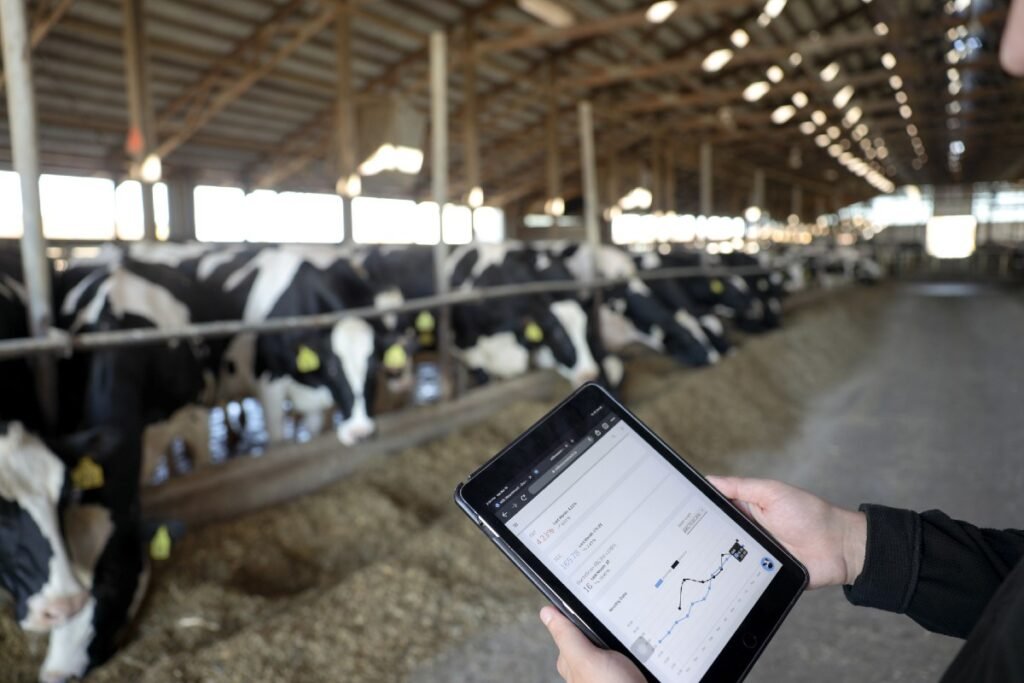
Milk Moovement software is used at a farm, with an iPad tracking production and quality data. (Photo: CNW Group/Milk Moovement)| Photo: CNW Group/Milk Moovement
Data is the most valuable asset
The dairy transportation sector has historically relied on operational experience and manual coordination. That model is changing quickly.
The International Dairy Foods Association (IDFA) encourages processors to audit current transportation processes and implement stronger compliance practices.
Sherrod said transportation teams are now managing a growing ecosystem of applications and digital platforms. Western Dairy Transport has placed significant emphasis on transportation management systems and using data more intentionally.
“We’re being able to track load times, driver productivity, equipment utilization – all those things that help us identify trends and fix issues before they become bigger,” Sherrod said.
The company is also investing in AI-enabled in-cab camera systems that identify driver behaviors and support more targeted coaching and recognition programs.
Sherrod thinks the next phase of dairy transportation will center on visibility.
“Customers want to be able to see where their product is, what the temperature is, when it’s going to arrive,” he said.
That expectation is echoed throughout the broader dairy technology landscape.
Milk Moovement describes predictive transportation systems as an emerging advantage because static scheduling struggles to keep pace with dynamic milk production conditions. Predictive analytics enables collection schedules to adjust in real time, improving pickup efficiency and reducing idle time across transportation networks.
The company also emphasizes that real-time visibility and integrated analytics support faster decision-making and more efficient coordination between transportation and processing operations.
Compliance and risk management
As dairy transportation grows more connected, compliance expectations are expanding as well.
According to Ever.Ag, with nearly 70% of US agricultural freight moving by truck, freight compliance is becoming a strategic issue rather than simply an operational requirement.
A combination of proposed regulatory changes, insurance cost increases and greater legal accountability is reshaping transportation decision-making across agriculture.
For dairy processors, the implications are significant. In an industry where delivery timing directly affects product quality and customer commitments, a single compliance failure can disrupt production schedules and create downstream supply chain consequences.
To reduce exposure, agribusinesses are strengthening oversight through pre-dispatch checks, clearer compliance standards and digital monitoring tools that provide real-time alerts.
“Transportation compliance has become one of the most important, yet underappreciated, levers for safeguarding margin and customer trust in agriculture,” said Ben Sloan, vice president of transportation management at Ever.Ag. “Every mile now carries more legal and financial weight than ever before.”
Equipment strategy is becoming part of that risk equation.
Don Durm, vice president of supply chain solutions at PLM Fleet, said dairy operators increasingly need better ways to manage transportation assets and make decisions from equipment data rather than instinct.
PLM Fleet operates approximately 15,000 temperature-controlled trailers across North America and works with dairy processors to improve visibility and compliance.
Durm thinks predictive asset management will become increasingly important as refrigerated fleets age. He noted that older refrigerated trailers lose thermal efficiency over time, increasing fuel consumption and reducing cold-chain performance.
“Investing in technology and tankers and insulation and different things to maintain that that temperature in the tankers is a huge factor for us,” Durm said. “That’s the biggest thing that we face, perishability-wise, is keeping that milk cool on a tanker, making sure it’s loaded at the proper temperature.”
Durm said telematics has evolved rapidly, but too much information can become its own obstacle. In the past, operators used telematics reactively — pulling data only after something went wrong. AI is changing that by introducing predictive analysis that identifies transportation risks before they become operational failures.
“AI gives us the ability to look at foresight, to be able to take a look at the predictive analysis of potential risks that we’re going to be dealing with,” he said.